Building
Since its construction our historic building has been owned by a collaboration of different groups. All of the buildings current owner groups are listed in Organizations with a short description and links to their respective websites for you to learn more about each of their rich traditions.
LOCAL HISTORY
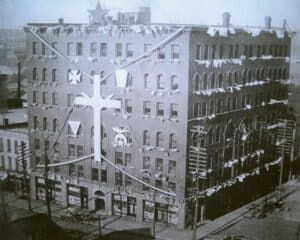 For many years the Masonic bodies in the Grand Rapids area met in various halls of the city as suited the convenience of the membership. When the Masonic meeting areas were planned for by Cotton Fox 32° at the corner of North Ionia and Louis streets, an offer was made that if all the Masonic bodies would take long time leases the upper stories of the seven story building would be constructed with special reference to the needs of Masonry for those floors and that the building should be called the Masonic Temple (but the bottom floors would be leased out to other purposes and businesses). The building was soon constructed and was completed in 1895. The Masonic bodies took possession of their quarters on October 15, 1895.
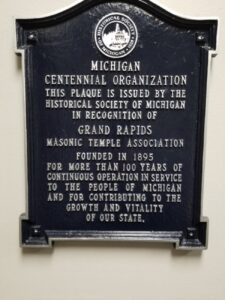 The Masonic Temple Association of Grand Rapids, Michigan was organized on October 12, 1895, and governed by Michigan Public Act 1 of 1895. Its creation is for the purpose of providing and maintaining a building or buildings to be used for Masonic purposes and the rental of other areas of its buildings to private entities and for public events. It was incorporated on November 10, 1906, for 30 years, renewed on October 23, 1936, for 30 years, and articles updated to Non-Profit on October 19,1951. On February 24, 1966, the articles of incorporation were amended to a “corporate existence of the Masonic Temple Association of Grand Rapids, Michigan shall be perpetual”. This Association is a title-holding corporation 501(c)2 Non-profit overseeing the maintenance and operations of the facility and adhering to the Michigan Nonprofit Corporation Act 162 of 1982 as amended.
When the Masonic Temple Association of Grand Rapids had incorporated in the early 1900’s the member organizations of the association were: Grand River Lodge No. 34, F. & A. M.; Valley City Lodge No. 86 F. & A. M.; Doric Lodge No. 342, F. & A. M.; York Lodge No. 410, F. & A. M.; Malta Lodge No. 465, F. & A. M.; Grand Rapids Chapter No. 7, R.A.M.; Columbia Chapter No. 133, R.A.M.; DeMolai Commandery No. 5, K.T.; DeWitt Clinton Consistory, A.A.S.R.; Past Masters’ Association, Saladin Temple, A.A.O.N.M.S.; Oriental Chapter No. 32, O.E.S.; Peninsular Chapter No.65, O.E.S.; Palestine Shrine No. 1, O.W.S. of J..
Today the member organizations of the Masonic Temple Association of Grand Rapids, Michigan are Ancient Accepted Scottish Rite, Valley of Michigan, Southwest Region; DeMolai Commandery No.5, Knights Templar; Grand Rapids Lodge No. 34, Free & Accepted Masons; Doric Lodge No. 342, Free & Accepted Masons; Grand Rapids Chapter No.7, Royal Arch Masons; Peninsular Chapter No. 65, Order of Eastern Star.
1911-1915
As years progressed a larger Masonic Temple was needed, and one was proposed during a meeting to be devoted exclusively to Masonic purposes and lodge home for various bodies. It was at this meeting that Sir Knight William E. Elliott, Commander of DeMolai No. 5 Knights Templar of Grand Rapids Michigan came forward in April 13, 1911, to under right $200,000 (in 2017 value would be $4,810,000) the building project of a new masonic Temple, providing the lodges would raise the remaining $200,000. The proposal was that the interest on $100,000 to be paid to him during his life, and then to his wife in the event of his death and to his mother if she survived them both, and then the principal would revert to the Masonic Temple Association upon all of their death. The remaining $100,000 to be payable in 25 years, meanwhile it would draw interest at 5.5 percent (when many banks were charging 12%). It was stated that his magnanimous proposition of financing that was made by William E. Elliott PC, was the action that made the enterprise possible without several years of waiting and delays which assured the Masonic Temple Association of a donation as the current building fund had about $87,000. With this donation now $113,000 would have to be raised in about 20 months. It was said of William E. Elliott his generosity was a practical and noble exemplification of the true spirit of Masonry.
The Masonic Temple Association approved the architect plans of Osgood & Osgood on May 15, 1914, and contract awarded August 20, 1914.
The groundbreaking for the Grand Rapids Masonic Temple occurred on June 11, 1914, with the first shovelful of earth was turned by William E. Elliott a prominent mason and local businessman.
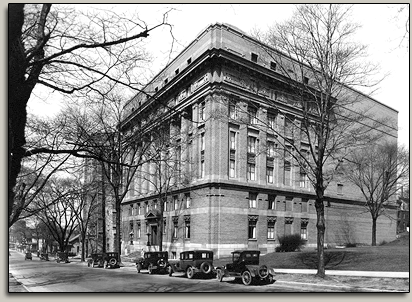
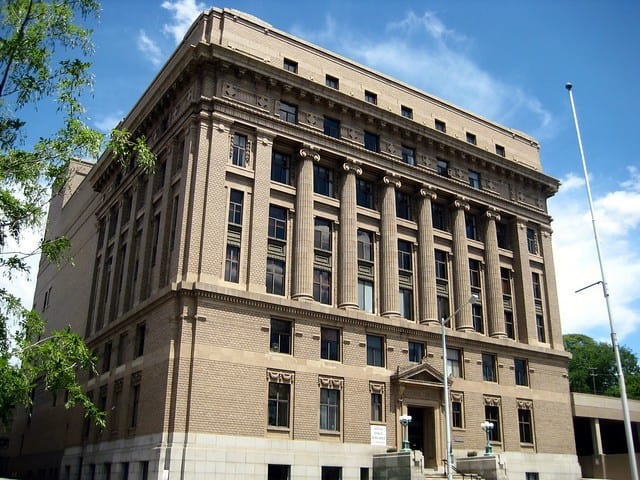
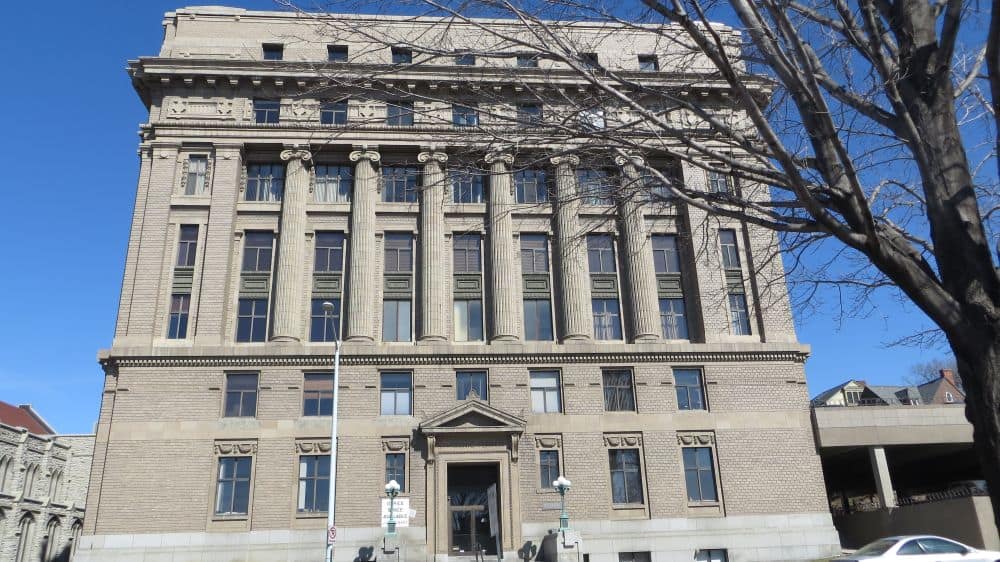
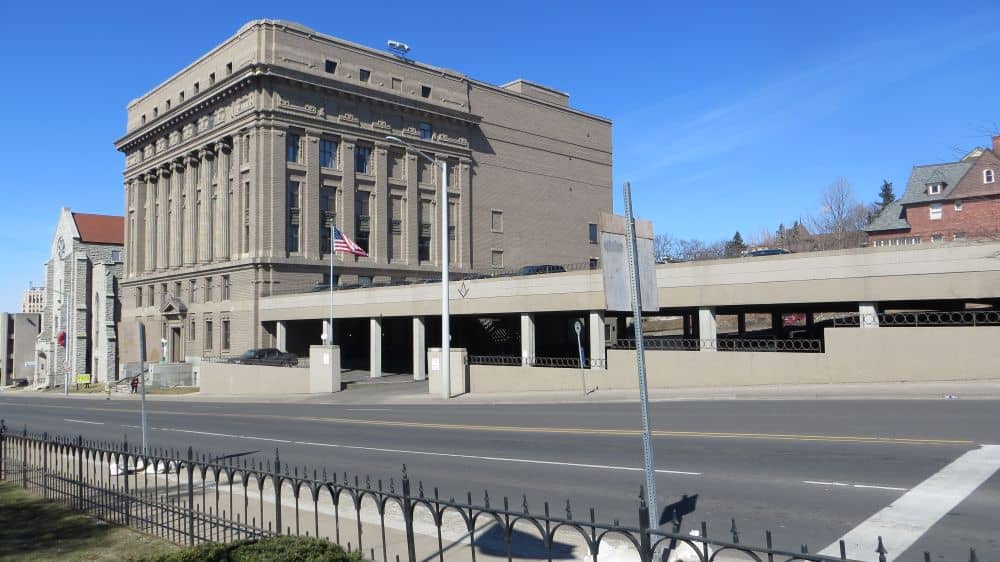
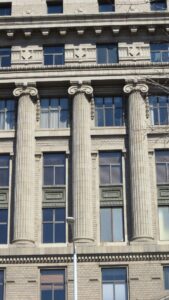
Constructed in 1915 by the local Grand Rapids Michigan architectural firm Osgood & Osgood, the Grand Rapids Masonic Center stands today as a sound example of an early 20th century Masonic Temple building. Osgood & Osgood were also members of the fraternity in Grand Rapids. They built the Grand Rapids Masonic Temple in the Federal (Neoclassical Revival) Style. The Neoclassical Revival experienced its peak of popularity between 1900-1929. Directly inspired by the Beaux-Arts style and the Columbian Exposition (Chicago World’s Fair, 1893), the style tends to include the features of classical symmetry, with columns and temple front, and various classical ornament such as dentil cornices. Neoclassicism became the standard for a wide range of everyday buildings from townhouses and suburban homes- to public buildings such as county courthouses, main street commercial buildings, and bank branches. Regarding the early 20th century era of Masonic "Temple Building", this reflects the growth in numbers (and wealth) of the fraternity at that time.
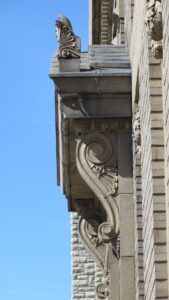
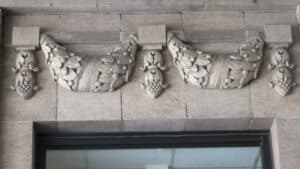
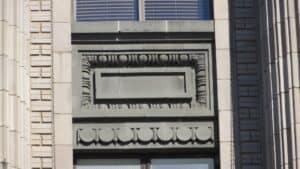
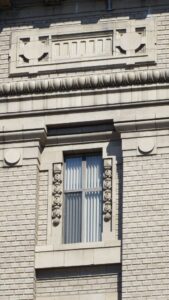
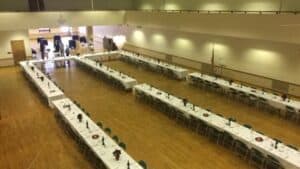
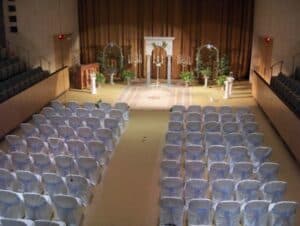
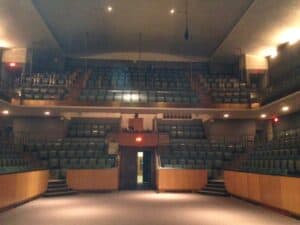
The Fulton Street Masonic Temple would be made of granite, brick, and terra-cotta stone. The use of six 45 feet high upright pillars on the front gives it a Grecian look. For the lobby, staircase and walls marble was used. While it is a seven-story building, it consists of a basement and six floors because the banquet room was set up as two stories in height to seat up to 500. The fifth-floor theatre is built like a Roman Amphitheatre that also houses a Moller pipe organ.
CORNERSTONE EVENT: The front page of the January 14, 1915, Grand Rapids Herald reported, "Today marks a new era in the history of masonry in western Michigan. The day will witness the laying of the cornerstone of the most pretentious structure devoted to fraternal purposes in the western part of the state, when the magnificent new temple erected by the masonic fraternity in Grand Rapids is completed there will be nothing in the state to equal it, with a single possible exception. The ceremony will be conducted with simple accompaniments, but no less solemn because of its simplicity. The cornerstone containing the archives of the lodges of Free and Accepted Masons in Grand Rapids, will be laid according to ancient Masonic usage, in the present of the officers of the Grand Lodge of Michigan, F. & A. M., Grand Chapter of the Easter Star and White Shrine of Jerusalem. The official act of placing the unpretentious block of granite where it will stand for ages to come will be performed by Grand Master William M. Perrett, of Detroit, assisted by other Grand Lodge officers. Preceding the cornerstone exercise, the five masonic lodges and co-ordinate bodies will march to the site on Fulton Street, between Barclay and Lafayette avenues, and participate in the exercises. While the exercises attending the placing of the cornerstone will be impressive and attended with deep fraternal significance, the banquet at the Coliseum in the evening will be a crowning feature of the most auspicious and significant masonic event in the history of Grand Rapids and western Michigan. The forenoon will be devoted to the reception of distinguished officers of the Grand Lodge, and co-ordinate bodies, Supreme Chapter White Shrine of Jerusalem and Grand Chapter order of the Eastern Star." "The order of the morning exercises will begin with assembling of masonic bodies at 11 a.m. at the Temple, lonia Avenue and Louis Street, under the direction of William E. Elliott, Marshal, who will superintend the line of march and disposition of the numerous bodies at the new Temple for the ceremonies. The column will march through lonia Avenue to Monroe Avenue, thence direct to the Temple. The parade will be led by the Furniture City band, DeMolai Commandery, Knights Templar, acting as escort. Following will be the five Blue Lodges, each lodge to be headed by a Knight Templar in uniform, aids of Marshal Elliott. Following the lodges will be automobiles containing the distinguished guests from various parts of the state, the autos being led by Malta band. Governor Woodbridge N, Ferris, United States Senator William Alden Smith, Former Governor Chase S. Osborn, John J. Carton, Deputy Supreme Council Thirty-Third Degree; Grand Master William M. Perrett, Detroit;....". "Grand Eminent Commander Gordon R. Campbell...." "John I. McMallum, Grand Master R.A.M.; Mrs. Emma Ecobock, Worth Associate Grand Matron of the General Grand Chapter, O.E.S. of the United States,". After the laying of the cornerstone a program at the Coliseum will be held where the Michigan State Governor will speak. Honors will be given to William E. Elliott 33°, “The Man Who Made It Possible". "The copper box containing the historical data for the cornerstone was sealed yesterday afternoon at 5 o'clock.
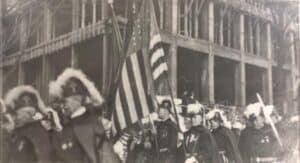
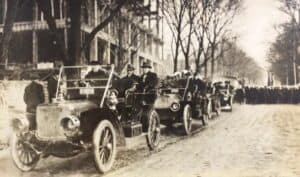
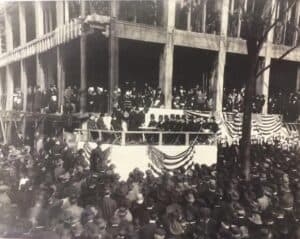
The January 15, 1915 Grand Rapids Herald reported the Cornerstone laying event in detail. At "High Twelve," Thursday, January 14, 1915, was the event of laying the corner stone for the new Grand Rapids Masonic Temple where 3,400 persons claim membership in different masonic bodies. Ceremony headed by Grand Master William E. Perrett of Detroit, head of the Grand Lodge of Free and Accepted Masons (F&AM) Michigan. The parade Marshal was William E. Elliott Past Commander of DeMolai No. 5, and with him in charge of the parade it was stated that it was a total success without any problems. The parade started at the current Temple building (which many still called the Fox building) and had 200 DeMolai No. 5 Sir Knights which was led by another Past Commander, Charles I. Buell, who had them formed into 14 platoons was the parade escort as they lead them to the new Temple on Fulton that was under construction on this cloudy day. Following was the Furniture City Band and following them was white horse drawn carriages. The first one was carrying VIPs of the Grand Lodge; and second one U.S. Senator William A. Smith. Following these were Automobiles with other VIPs. Some of the special VIPs that were present for the event and celebrations after the laying of the cornerstone were Current Michigan Governor Woodbridge Nathan Ferris (1913-1917) (Master Mason), former Michigan Governor Chase S. Osborn (1911-1913). United States Senator from Michigan William Alden Smith (1907-1919) (Sir Knight and 33°), Grand Rapids Mayor George E. Ellis (Past Grand Patron of the Grand Chapter of the O.E.S. of Michigan), Right Eminent Grand Commander Gordon R. Campbell of Knights Templar of Michigan, John J. Carton Deputy for Michigan Supreme Council 33rd Degree Ancient and Accepted Scottish Rite (A.A.S.R.), John I. McCallum Most Illustrious Grand Master Royal & Select Masons of Michigan, Mrs. Emma Ocobock Worth Associate Grand Matron of the General Grand Chapter O.E.S. of United States, Herbert Montague Past Grand Master and Superintendent of the Masonic Home in Alma, and John Rowson (1901 DeMolai Commander and Past Grand Master) President of Masonic Temple Association (MTA), Grand Generalissimo Mark Norris (Past Commander of DeMolai No. 5, and future Grand Commander of Michigan (1917, and future Grand Commander of the Grand Encampment [1937-1940]). Before the start of the corner stone ceremonies the DeMolai No. 5 Commandery Sir Knights were at their post of Honor at the corner entrance of the building. At "High Twelve" when the flag that had been draped block of corner stone of granite which all where here to honor, as this United States Flag was slowly raised, the Furniture City band played, “The Star-Spangled Banner" which swelled upon the air and the vest crowd stood uncovered in respectful homage while the strokes of 12 were tolled in ringing tones. As the corner stone was hanging and ready to be placed, the cement applied to the area with the symbolic workman's tool that cements all good men together, the trowel, as the Worshipful William M. Perrett of the Grand Lodge of Michigan, (who would later receive the Masters trowel in honor of this event), as he was to apply the cement just as the stone was set in place and bind the stone to the main structure, the inspiring strains of "America" added a patriotic solemnity to the scene.
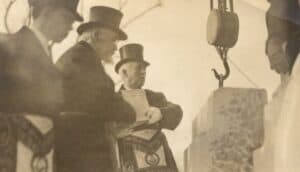
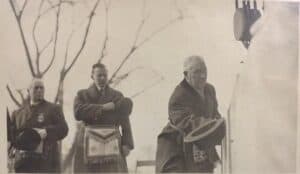
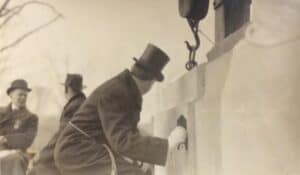
The Divine blessing was invoked by Grand Chaplain William H. Gallagher. Then the Past Grand Master and acting President of the Masonic Temple Association, John Rowson, invited the Grand Lodge to lay the corner stone with due ceremony in accordance with Masonic custom. He said, “Most Worshipful Grand Master, the masonic fraternity of this city being animated by sincere desire to promote the social uplift and general welfare of the craft in this part of our, grand jurisdiction, have undertaken to erect on the place we now stand, a Temple to be devoted to the exclusive uses of our order and its branches. We hope it may long serve the purpose for which it is being constructed; that strength and beauty may adorn all its parts and wisdom continually go forth from within its walls to enlighten its members and this community. On behalf of the Masonic Temple Association, I now most respectfully request that you lay the cornerstone, thereof, according to the form and ceremonies of our ancient and honorable fraternity." Then John H.P. Hughart 33° and Past Commander of DeMolai No. 5 (1902), he was the custodian of the copper box containing the historical data, which at this time he presented the box to the Worshipful Grand Master. While the cement was being prepared the Furniture City band played "Solders of the Cross". The box was then given to Grand Treasure William Wente, and now the band was once again playing, “The Star-Spangled Banner", and he deposit the copper box into the corner stone and cement was applied. The working tools of the craft were then presented to the Grand Master, the square, compass, and level. These were presented to Grand Marshal Ira Beck in turn to Deputy Grand Master George L. Lusk, who made the ritualistic test with the square. Senior Grand Warden John H. Hawks, who made the test with the level, and to Junior Grand Warden Louis H. Fead, who made the compass test, Grand Marshal Beck then pronounced the stone "plumb, squire and level”, in this proclamation due from his office, then grand honors were given by officers and members.
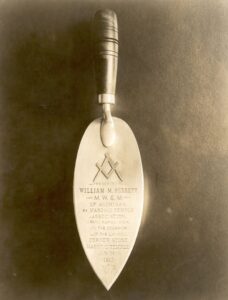
The celebration included presenting the master trowel to Worshipful Grand Master of the Grand Lodge of Michigan William M. Perrett. The trowel was described as finished in steel highly polished, bearing the square and compass in heave raised gold with this inscription, "Presented to William M Perrett, M.W.G.M. (Master Worshipful Grand Master of Michigan F. & A. M. of Michigan), by the Masonic Temple Association of Grand Rapids, Michigan, on the occasion of the laying, of the corner stone, Masonic Temple, January 14, 1915." The Worshipful Grand Master was deeply moved and for several moments his emotions prevented him in giving a reply. However, when he recovered, he expressed great appreciation in terms that wept deep into the hearts of every Mason present. Then Michigan Governor Woodbridge N. Ferris rendered kind remarks the great impulse of the industrial world and man's constructive power. The governor drawing a parallel with these things and this new Mason Temple which illustrated that genius of construction impulse which demonstrated the Masons in Grand Rapids to give to coming generations and the community a building that would exemplify the true principles of Masonry, and by this illustration show that it was this constructive element that built communities, states and nations. He stated, "Your temple is illustrative of the work of the head and heart. I congratulate you because it stands for all those things which make for the construction of charter, and your purpose and impulse has been exemplified in that beautiful structure. It is a glorious thing to look upon. It is not simple for you, but for the whole community, an exemplification of the brotherhood and the principles in which you glory."
An impressive portion of the ceremony was the spreading of corn upon the stone, emblematic of joy; and wine, emblematic of refreshment, by the Deputy Grand Master, Grand Marshal and Senior Grand Warden, respectively, the contents of the cornerstone were read by Grand Secretary Lou B. Winsor and copies of The Grand Rapids Herald of January 3 and 10.
MILESTONES EVENTS:
1927
Going to this link https://www.youtube.com/watch?v=XgESD6orYmA is a video made in 1927 where the Grand Rapids Masonic Temple had hosted the 83rd Annual Communication of the Grand Lodge of Michigan (May 24-25, 1927). Front View of Building. Shots looking West down Fulton Street. Shots in the grassy area are taken from the East side of building (now a parking structure) looking North and Northeast. Scanned by Fraternal Film Archive using a Laser graphics Scan station. Original scan in 6.5K taken from 16mm film reel on July 21, 2021. The scan was subsequently color-corrected and had dust/scratch removal performed using restoration software. The two distinguished visitors are John A. Rowland and William M. Logan described in the Grand Lodge proceedings as being from the 'Grand Lodge of Canada'. Also shown in video are Frank O. Gilbert (Grand Master of Michigan 1901-1902), George Graves (Grand Master of Michigan 1927-1928), F. Homer Newton (Grand Master of Michigan 1928-1929), George A. Ferguson (Grand Master of Michigan 1933-1934), Roscoe O. Bonisteel (Grand Master of Michigan 1929-1930), James P. McGregor (Grand Tiler), William H. Gallagher (Grand Chaplain), and Lou B. Winsor (Past Grand Master of Michigan 1897, Grand Secretary, seen 'jaw jacking' and laughing with Grand Lodge Officers). Easter Egg -- Look closely for the Anheuser-Busch delivery truck that appears briefly just past First United Methodist Church coming from Barclay Ave onto Fulton Street. (From Fraternal Films)
1947
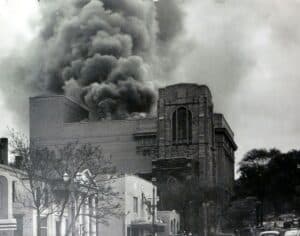
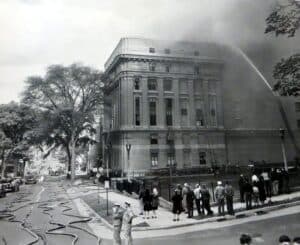
The Memorial Day fire of May 26, 1947, caused million-dollar damage to the Amphitheater, the surrounding floor areas and especially the roof. The MTA Meeting minutes of January 1948 record the fire damage at $1,031,068.98 or in 2024 dollars of $14,587,221.78 – which the fire insurance paid for about 50%, leaving the MTA Organizations to supply the remainder. Which they did with an additional or Special Assessment of $531,881 as voted in January 1948, (in 2024 dollars of $ 7,524,875.89); and the member organizations had the Special Assessment fully paid off by April 1950! The building was quickly repaired, and the Amphitheater was back in use within two years.
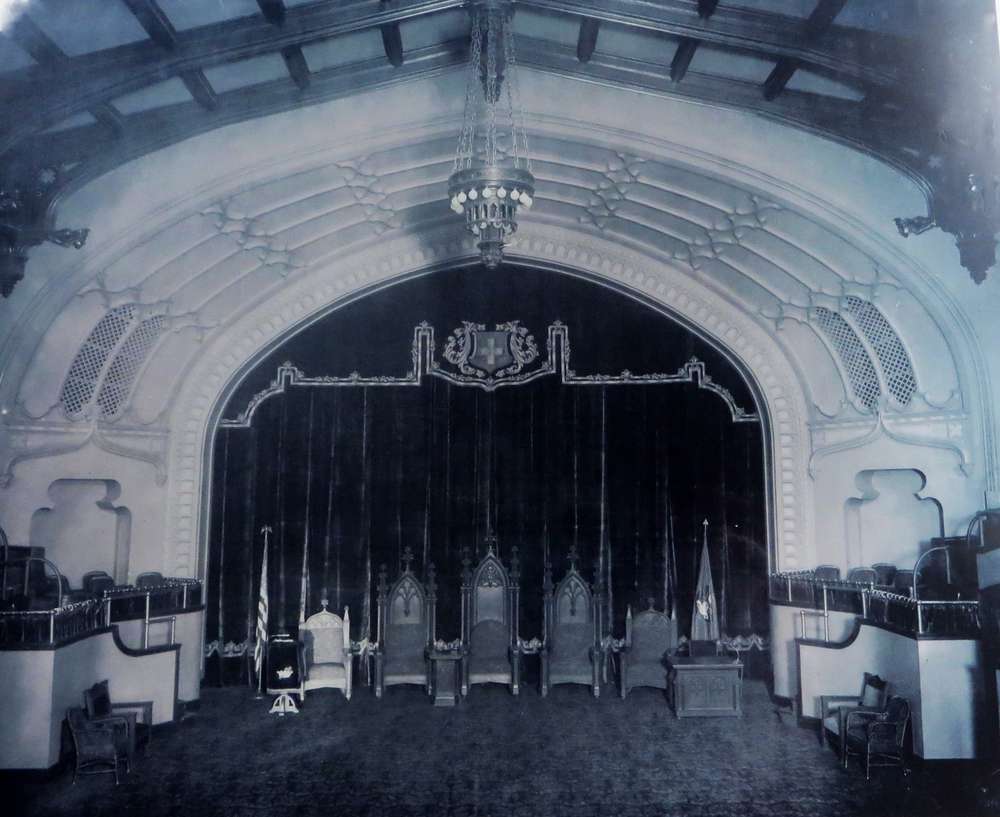
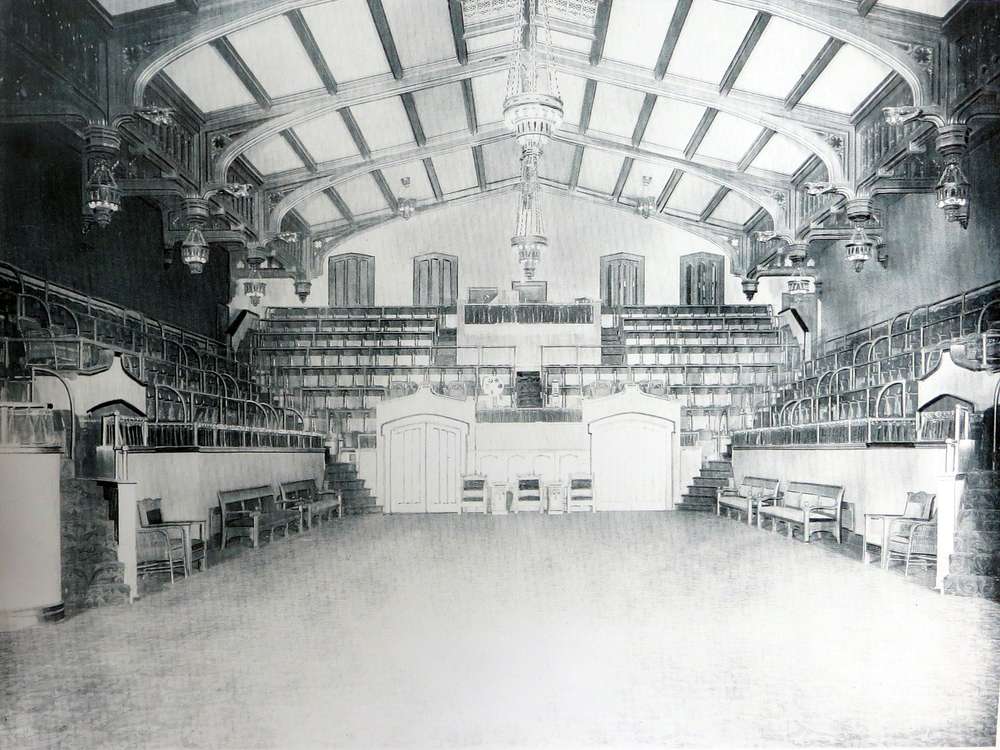
Below is the 1916 stage as it looked, and the main stage curtain protected the 75 hand painted backdrops that were purchased and installed at the opening of the 1915 building. Look closely at the backdrop as it is still in use today, in color below.



 Today: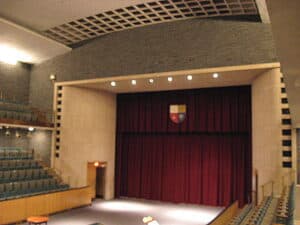
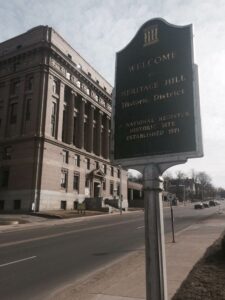
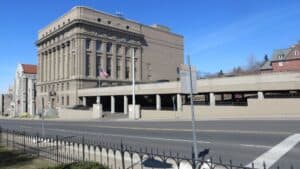 In 1971 changes were made to protect from urban developments that threatened the destruction of many architecturally significant buildings and homes. The residential neighborhood that the Masonic Temple was situated in received designation as a National Historic District by the National Register of Historic Places, it is now known as the Heritage Hill Historic District. A single level parking structure was added to the east side of the Masonic Temple in 1975 and the St. Johns parking area. In 2000 a major interior remodeling project of the Lower-Level floors was completed. In 2025 the passenger elevators are being replaced.


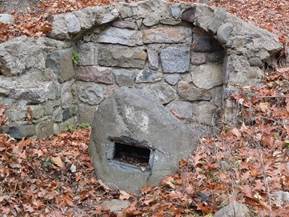 In 2015 marked the centennial of the Grand Rapids Masonic Center where a special stone was moved to the property at a location within the southeast parking area where a time capsule was stored within it. More information: https://www.mlive.com/news/grand-rapids/2013/10/lost_in_time_3000_pound_masoni.html
Over the course of one century, this building has stood through economic hard times such as the Great Depression and has sustained the losses of its brothers through war. It has served the community in many various ways, providing a location for the military of WWI and WWII for personnel to obtain coffee and a meal in the banquet room or entertainment in the Amphitheater, hosting church services, weddings and receptions, Boy Scout activities, Swing dancing, continually being a resource of its community where it has been located for over 100 years as well support the community through charity contributions. There is a wealth of beauty and history to this place. By exploring a physical tour of this building, you will be able to see the history of its changes over the years, and how those changes reflect cultural and societal transition throughout 100 years. Since its design approval in 1914 by the Masonic Temple Association of Grand Rapids (MTA), this MTA has continuously owned and operated the 233 Fulton Street East facility ever since for the use by Masons and the public.
A short film in 2015 about the opening of the Masonic Temple in Grand Rapids, MI in 1915 and a little history about the building that is celebrating its 100-year anniversary, click on Play:
2023-2025 Elevators Replacement Project
As the State of Michigan was changing its elevator codes and they were to go into effect in 2027, the Masonic Temple Association (MTA) Elevator Modernization project was officially kicked off in December of 2023 when the MTA House Committee contracted with The Elevator Consultants a National Consulting group out of Chicago to assist the MTA with developing scope of work to ensure the MTA was 100% compliant with the new Michigan State elevator codes with their review of the project items of equipment specifications, preparation of contractor bid package and assessment of bids. The MTA received four bids from elevator contractors. After reviewing the bids and upon receiving several outstanding references from other Masonic Temple Associations about one of the companies, the MTA selected a family-owned elevator contractor out of the Kalamazoo area, McNally Elevator Service, to complete this project. The two elevators for passenger transport were completely replaced, and the freight elevator was upgraded with the goal of retaining as many of the characteristics of the current cab while meeting code requirements. While our MTA House Committee was working on the project deliverables the MTA Finance committee was diligently working on funding the over $1.2M project and MTA employees daily interfacing with the contractors and tenants to successfully handle situations as the project evolved. It’s been a long process with countless volunteer hours of MTA Board of Trustees and MTA committee that worked towards the long-term viability of our facility and what our volunteer members and employees do to make it a successful meeting place we have enjoyed since laying the cornerstone in 1915 by freemasons.
Early 1900's Promotional Film of Grand Rapids Michigan. Grand Rapids the Gateway to the Playground of a Nation, and the Furniture Capitol of America. (The New Masonic Temple is in the film after the 1915 time period.) : https://www.youtube.com/watch?v=FbthZfA6ZYc